What Is Kneading and What Does It Do?
To make bread that is light, fluffy, and chewy, you must properly knead the dough. Kneading develops gluten, which gives yeasted bread chew, by combining air, distributing ingredients, and most importantly imitating the action of a human hand. Mixing starts the process by forming a weak and disorganized matrix of gluten proteins.
You may generally knead bread doughs by hand or with a stand mixer (we'll go through each method in depth below). While hand kneading is enjoyable, we recommend using a stand mixer with the dough hook attachment for this job. Not only is it simpler—the mixer does all of the work—but you're more likely to get consistent results.

Kneading dough by hand might be time-consuming and messy, and many home cooks add a lot of extra flour, which can affect the texture of the baked loaf. On a practical level, kneading dough fully by hand takes up to 25 minutes—and some well-developed forearm muscles—while kneading in the stand mixer with the dough hook attachment takes 8 to 12 minutes.
However, if you don't own a stand mixer, you may still make a nice loaf of bread from most doughs. The secret is to work the dough in a rhythmic, gentle manner that extends and massages it.
When is the Bread Dough Properly Kneaded?
There are two ways to tell if your dough has been kneaded long enough so that the gluten has fully developed.
1. Is the dough clear of the bowl's sides? If not, keep working. The dough on the left (see below) is still adhering slightly to the side of the bowl. The dough on the right (see below) clears away from the wall of the bowl completely.
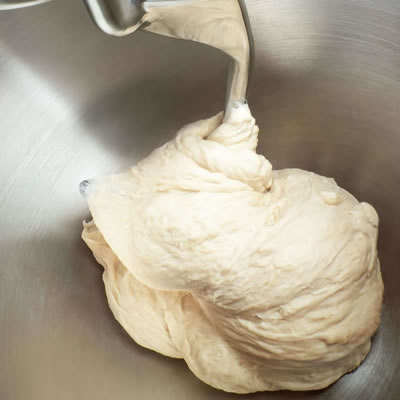
3. Is the dough elastic? If not, continue kneading. The dough in the upper right may be stretched like a rubber band without snapping back into place. When pulled on the dough on the left, it breaks because the gluten proteins have yet to link together into a robust mesh.
What Happens if You Overknead Dough?
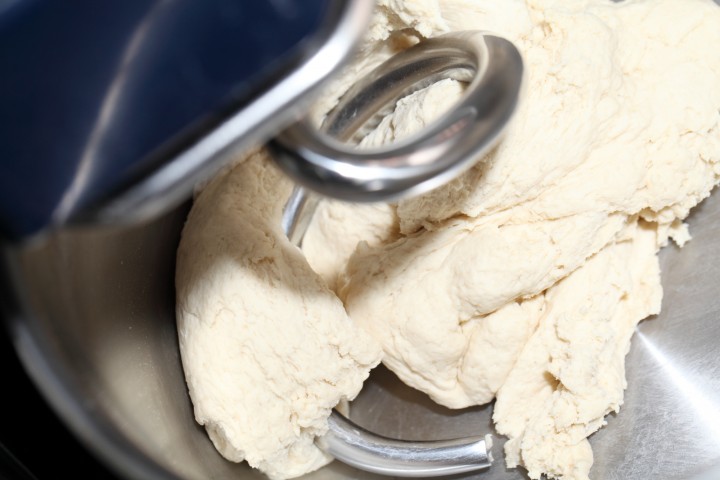
Proper kneading is essential for creating gluten in doughs, but there may be too much of a good thing. Overkneading causes the dough to heat up and change from a wheaty tan color to a pale white, resulting in loaves with a sickly pallor and stale tastes.If the dough is kneaded for too long, the action of a stand mixer's dough hook generates too much heat through friction and kneads in excessive amounts of air, bleaching it of taste and color. Once your dough has cleared the sides of the bowl and feels smooth and elastic, quit mixing.
Alternate Method: Kneading in a Food Processor
We don't like the rough treatment of a food processor when making bread, which can damage the strands of gluten that give bread structure and enable it to rise. When we want chew but less structural integrity is required, we prefer to use our food processor.Many of these doughs would normally take 15 to 20 minutes on the stand mixer to become a glossy, elastic mass—but less than 2 minutes in the food processor. The only exceptions in this category are doughs with huge outputs that are extremely wet. Here's how to get the best results possible.


Comments
Post a Comment